
8 Mistakes People Make When Choosing Decorative Wall Panels (And How to Avoid Every One)

Here’s a scenario that plays out more often than it should.
Someone spends weeks picking the right decorative wall panels for their living room. They go to the showroom, pick a finish they love, get it installed and then stand back and feel vaguely disappointed. The room looks fine. But it doesn’t look like what they imagined. The panels feel too busy, or the finish looks different from the sample, or something about the scale just feels off.
Nothing went technically wrong. But several small decisions went wrong together. And because panels are a relatively permanent surface choice, there’s no quick fix.
This guide is about those decisions. The eight mistakes below aren’t theoretical; they’re the ones that recur when people choose interior wall panels without a clear framework. Read through before you order, not after.
Mistake 1: Picking Panel Width Based on What Looks Good in Photos
Showroom photos and Instagram interiors have a way of making 12-inch-wide panels look universally correct. They don’t.
Panel width determines the visual rhythm of your wall. Narrow panels 4 to 5 inches create a lot of lines. That repetition adds texture and energy, which works beautifully in a compact space where you want the wall to feel considered. Wide panels 12 inches do the opposite. Fewer lines, more breathing room, a cleaner and more architectural result. That suits larger spaces where simplicity creates impact.
The mistake is applying what looked good somewhere else to your specific room without accounting for its actual dimensions. A 12-inch-wide designer wall panel in a small bedroom can feel heavy and close. A 4-inch panel running across a 4-metre feature wall in an open-plan space can feel restless.
Before you commit to a width, take masking tape and mark out the panel lines on your wall. Stand back. Live with it for a day. That two-minute exercise has saved a lot of people from a three-week installation regret.
Mistake 2: Not Thinking About Ceiling Height Until the Panels Arrive
Most people think about panel width. Far fewer think about panel height until the delivery shows up and the maths doesn’t work.
Many modern residential rooms sit around 8–10 feet high. If you order 8-foot panels without accounting for that gap, you may need a visible join, trim detail, or transition to complete the installation. Unless intentionally detailed, the join can look more like a compromise than a design feature. It looks like a miscalculation.
The fix is simple: measure your floor-to-ceiling height before you choose a panel length, not after. For high-ceiling spaces 10 feet and above, look for panels that cover the full height without a horizontal break. Dexarte’s Altura Infinite (8 inch × 10 ft) was built specifically for this: its 10-foot height runs uninterrupted from floor to ceiling, helping create a more continuous visual appearance that shorter panels on tall walls simply can’t replicate.
Mistake 3: Falling for a Finish in Showroom Lighting
Showrooms are lit to make surfaces look their best. Your living room probably isn’t.
High-gloss metallic panels under warm, directional showroom lighting look extraordinary. Under a north-facing window on a cloudy afternoon, that same panel can look cold, flat, and a little cheap. The finish hasn’t changed; the light has.
This isn’t an argument against gloss or metallic finishes. It’s an argument for testing your actual decorative wall panel sample in your actual space before committing. Glossy finishes amplify whatever light is already there, brilliant in bright, well-lit rooms, unflattering in dim ones. Matte finishes diffuse light and create warmth, but can look muddy if the surrounding palette is also low-contrast. Metallic and sparkle finishes are often used as accents, though the right application depends on the design style and scale of the space.
Request physical samples from your supplier. Stick them to the wall. Check them at 9 am, at midday, and at 8 pm with the lamps on. That’s the only test that actually counts.
Mistake 4: Using Interior Wall Panels in the Wrong Environment
Not every panel material is built for every environment, and this is where people get caught out most expensively.
MDF-backed panels and some laminate systems may be vulnerable to swelling, warping, or delamination when exposed to prolonged moisture. The surface might look intact while the substrate behind it is slowly failing.
The rule is straightforward: wet and humid environments need genuinely moisture-resistant materials, not just panels marketed as “bathroom suitable.” For kitchens and bathrooms, acrylic-based interior wall panels are a suitable option. For high-traffic spaces, busy hallways, commercial interiors, and spaces with kids, surface hardness matters as much as finish. Dexarte’s Imparo (3.0 mm acrylic) is engineered for exactly this: it’s built to take daily contact without showing it, which is a different specification from a panel designed purely for aesthetics.
Mistake 5: Panelling Every Wall Because You Want Maximum Impact
This is the overenthusiasm mistake, and it’s understandable. You’ve invested in quality decorative wall panels, and you want to see them everywhere.
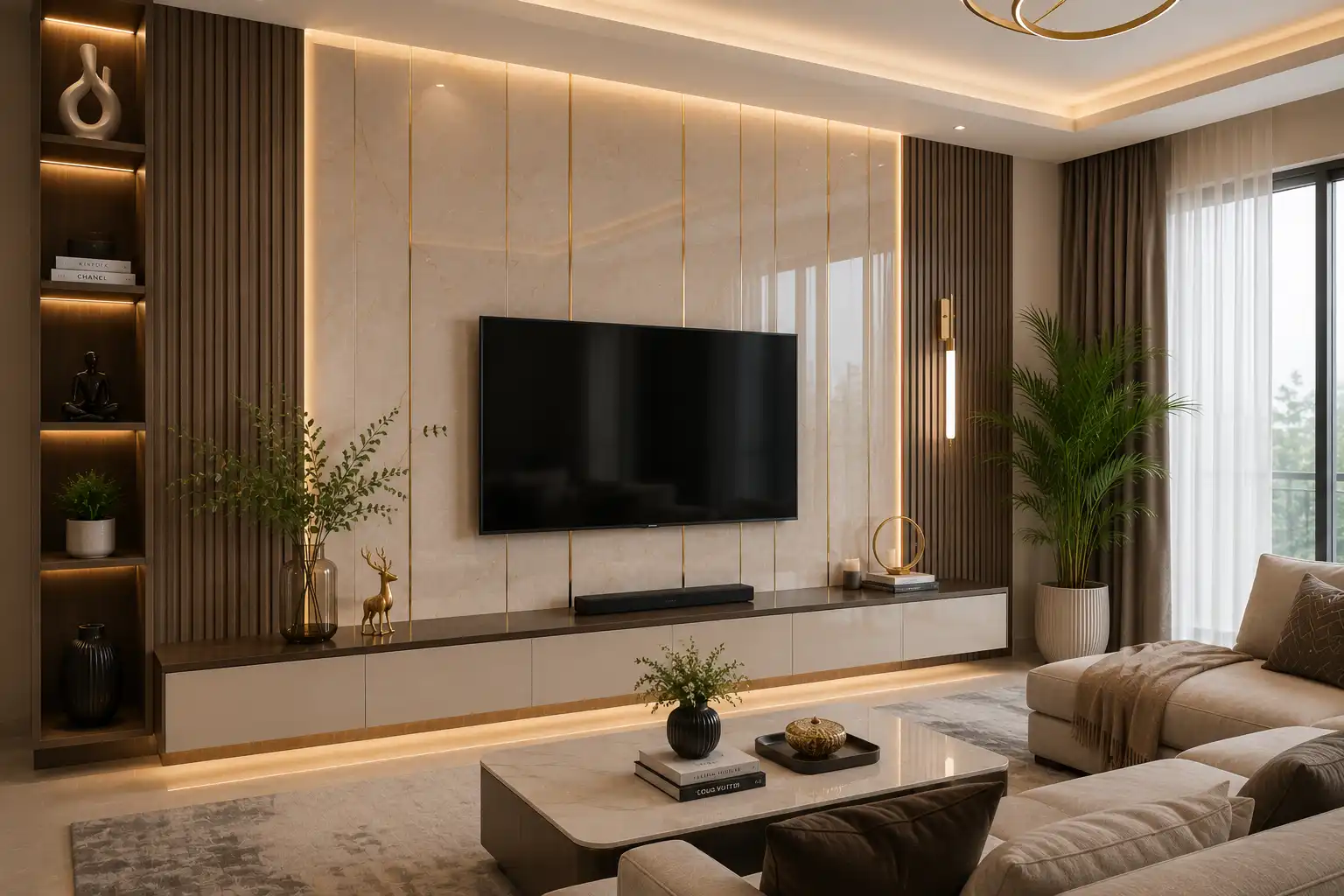
But panels derive their impact from contrast. A panelled wall reads as intentional and architectural because the surrounding walls are plain. Panel every surface identically, and the room stops feeling designed; it starts feeling wallpapered. The panels lose their presence because there’s nothing quiet to push against.
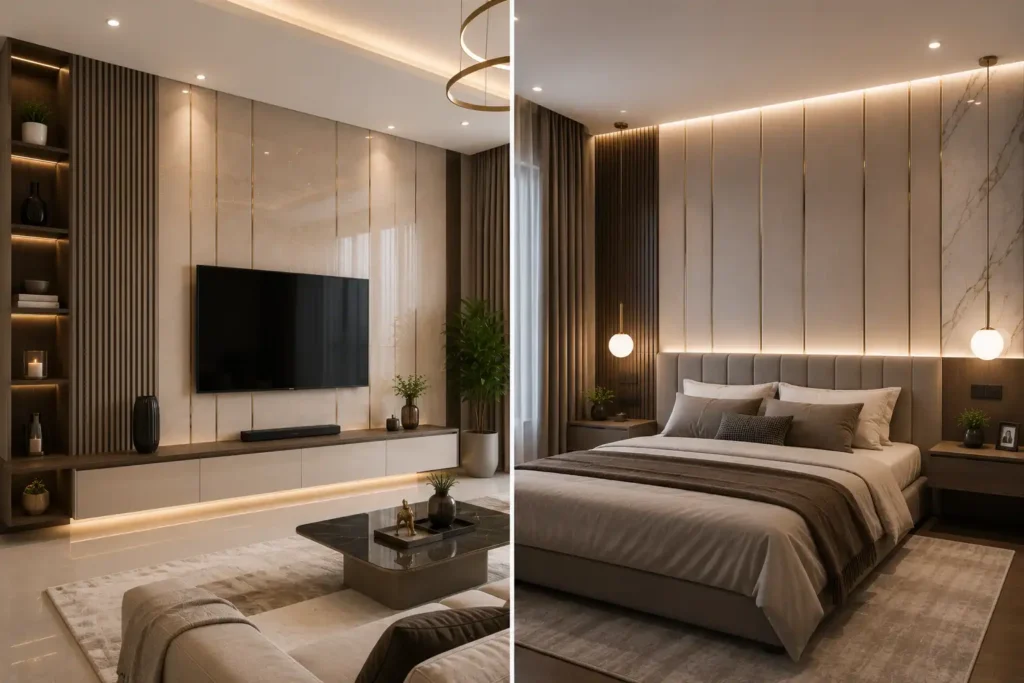
Pick the focal wall. The wall behind the sofa. The bed headwall. The wall you see first when you walk in. Panel that one surface with intention and let everything else stay simple. If you want to extend it further, bring the panelling in at a lower height on adjacent walls, a half-height treatment rather than floor-to-ceiling everywhere.
One wall done properly will always outperform four walls done adequately.
Mistake 6: Treating Installation as an Afterthought
The best designer wall panels money can buy will look wrong if they’re installed badly.
Misaligned panels, inconsistent gaps, visible fixings, panels that aren’t sitting flush because the wall behind them wasn’t properly prepared- these are all installation errors, and they’re visible every single day. No finish quality compensates for a wall that wasn’t levelled first or panels that weren’t fixed with the right adhesive spacing.
Installation cost is not a place to cut corners after spending properly on materials. Budget for it upfront. And make sure whoever installs the panels has worked with that specific panel system before. Acrylic panels, engineered polymer panels, and structural wall panels each have different handling requirements. The installer who is great with one isn’t automatically great with all three.
Mistake 7: Ordering Without Seeing a Physical Sample First
Website images are optimised. Brochure photography is lit and styled. Both are useful for shortlisting, but neither tells you how a panel actually looks in your space under your light.
This is especially true for textured finishes, fluted panels, matte surfaces, and anything with a three-dimensional quality. The depth and shadow play of a textured interior wall panel simply doesn’t translate through a photograph. You need to hold it, angle it under different light sources, and run your hand across it.
Request samples before you order. Every reputable supplier offers them. If a supplier doesn’t, that’s worth noting. View samples against your flooring, your furniture, and your existing wall colour. Check them at different times of day. Only then place the order.
Mistake 8: Choosing a Supplier on Price Alone
Two sheets can look identical in a product listing and be meaningfully different in quality. Surface hardness, colour consistency between batches, finish accuracy compared to the sample, thickness tolerance- these all vary between manufacturers, and none of it shows up in a price-per-sheet comparison.
The consequences show up later. Colour variation between panels from the same order. Surfaces that scratch more easily than expected. Sheets that arrive slightly off from what the sample showed. Replacing incorrectly specified panels after installation is always more expensive than getting the specification right the first time.
When evaluating a decorative wall panel supplier, ask about batch consistency and how they handle quality control. Request a sample that comes from actual production stock, not a dedicated sample unit. And look for suppliers who are specific about their material specifications, thickness tolerances, finish durability, and moisture resistance ratings rather than relying on marketing descriptions alone.
Dexarte publishes clear specifications across their full panel range, from the Altura wall panel series through to Essenczza and Dexiglas acrylic sheets, precisely because consistency between what you sample and what you receive is non-negotiable for installation quality.
How to Choose Decorative Wall Panels Without Regret
Most wall panel mistakes aren’t catastrophic decisions; they’re small misalignments that compound. Wrong width for the room size. Finish chosen under the wrong light. Material that wasn’t matched to the environment. Installation that was budgeted as an afterthought.
Get those fundamentals right and decorative wall panels do exactly what they’re supposed to: turn a flat wall into a surface that looks considered, holds up over time, and makes the rest of the room feel more designed just by being there.
Need Help Picking The Right Finish?
Each space has a function, and the right finish can completely change the look, feel and performance of that space over time. When designing a kitchen, wardrobe or feature wall, the best choice is to match the finish to the space, not just follow trends.
Contact Dexarte for expert advice, design inspiration and finish recommendations to help you create the right mood, function and visual harmony on every surface.
Follow Dexarte on Instagram, Facebook, and LinkedIn for inspiration and surface innovations.
FAQ
Q1. What are the biggest mistakes when choosing wall panels?
The common mistakes are choosing the wrong panel size, ignoring ceiling height, selecting finishes under showroom lighting, using the wrong material for the space, over-panelling, not getting samples and only considering price.
Q2. How do you select the right wall panel material?
Choose the material according to the installation place. Moisture-resistant panels are best for kitchens and bathrooms. For high-traffic areas, durable, scratch-resistant panels are a must.
Q3. Which wall panels are best for living rooms?
Select panels that match the size, lighting and style of the living room. They are often used on a feature wall to provide the best visual impact without overwhelming the space.
Q4. Are decorative wall panels suitable for bedrooms?
Yes. Decorative wall panels are a popular choice for bedroom feature walls, especially behind the bed, where they add texture, warmth, and visual interest.
Q5. How do wall panels compare with wallpaper?
Wall panels give you more depth, texture, and durability than wallpaper. They also look more architectural and will generally last longer when installed properly.