
The right acrylic sheet for kitchen cabinets, wardrobes or decorative walls depends on the finish you want and the construction behind it. Start with the room, the exact surface and a physical sample—not a blanket claim that one collection is best for every application.
Dexarte’s Essenczza, Dexiglas, Imparo and Engrave collections offer different decorative possibilities. This guide explains what to compare, where a separate wall-panel or APT specification may be relevant, and what to include when requesting product advice.
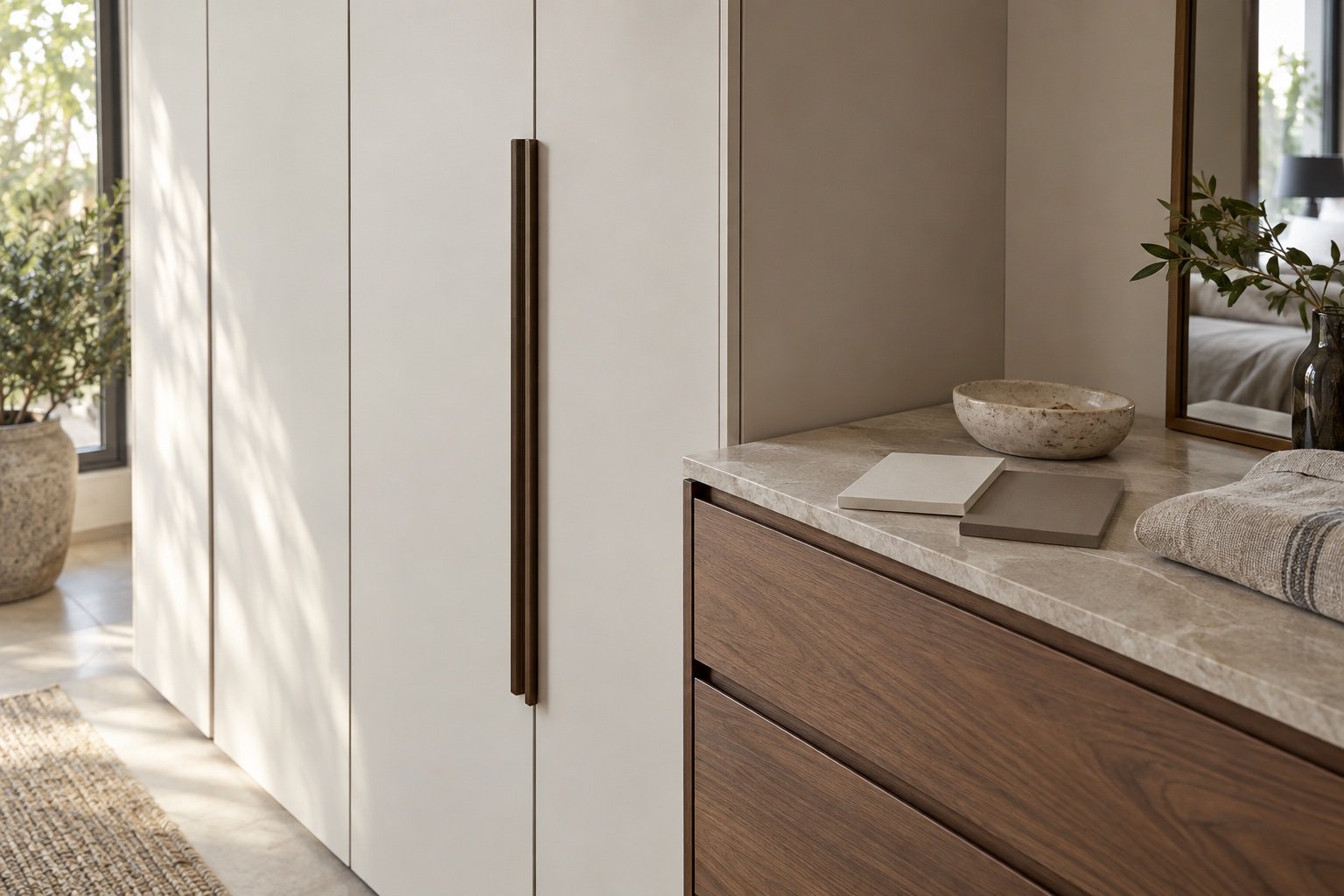
Compare the collection, finish and sheet specification
Thickness is one part of a specification, not a universal durability ranking. Compare the decorative effect, selected code, backing construction, fabrication requirements and approved application together. The decorative facing sheet is not the same thing as the complete cabinet shutter.
Essenczza: explore the colour and design selection
Essenczza offers a broad decorative selection. Begin with the actual colour and design codes in its catalogue. For a calm kitchen or wardrobe composition, compare the shortlisted sample with the flooring, countertop, upholstery and lighting rather than choosing a finish from a screen alone.
Request the current technical specification for the selected design. Do not assume that every finish has the same backing, surface treatment or performance characteristics.
Dexiglas: compare glass-like depth in a 2 mm sheet
Dexiglas is identified as a 2 mm acrylic range in the supplied catalogue. Its decorative character is relevant when you want to explore a glass-like look on cabinet faces or other approved interior surfaces.
View the sample at the distance from which the furniture will normally be seen. Reflections, nearby windows and the room’s lighting influence how the finish reads. A higher-gloss look is a design preference—not a reason to claim a product is universally better or worse for a particular room.
Imparo: a 3 mm range with metallic and pearlescent choices
Imparo is presented as a 3 mm glass-laminate range in the supplied catalogue. Its metallic and pearlescent choices give buyers another visual direction to compare with solid colours and other decorative finishes.
Choose Imparo for the approved finish and specification that suit the design. Do not infer a commercial-duty classification, an impact-resistance advantage over every other collection, or suitability near a cooking appliance simply from its thickness or premium positioning.
Engrave: review the exact design and flute effect
Engrave includes 3 mm decorative acrylic designs, with fluted options in the Craft collection. Inspect the selected design from the front and at an angle to understand its visual effect. Do not assume every Engrave design has the same flute pattern or surface texture.
Aagam recommends considering Engrave alongside Imparo when building a coordinated scheme. Treat that as a starting point for sample selection, not a guarantee that any two codes are a colour match.
Choosing acrylic sheets for kitchen cabinets
Separate cabinet-facing decisions from countertop and splashback decisions. A finish used on a cabinet door should not automatically be specified behind a hob or on a working surface.
- Cabinet and drawer fronts: compare the selected finish with your countertop, handles and floor. Ask the fabricator to confirm the substrate, adhesive, edge treatment and completed shutter construction.
- Tall units: assess the sample under the room’s lighting and check the proposed joint and edge details.
- Island fronts: specify the decorative vertical face separately from the countertop. They do not necessarily use the same material.
- Areas near cooking appliances: obtain explicit product-specific approval and observe appliance clearances. This guide does not recommend decorative acrylic as a cooktop splashback.
If your brief calls for a matte surface, also explore INNOVA APT Thermocore as a separate product specification. Read the ASA sheets vs APT buying guide if those terms are appearing in supplier conversations. APT and acrylic should not be treated as interchangeable material names.
Choosing a wardrobe finish
A wardrobe is a large part of a bedroom’s visual field. Compare a full sample beside the bed fabric, curtains and floor. Look at it in daylight and under the lighting you use in the evening.
You might choose one finish across the wardrobe or introduce a contrasting decorative section. Neither approach is inherently more premium. The important details are a coherent palette, the correct construction and a sample-approved finish.
Ask the fabricator to show the planned edge treatment and confirm how the facing sheet will be bonded to the substrate. Do not choose a hinge or shutter construction from the decorative sheet thickness alone.
Decorative walls: acrylic facing or wall panels?
For a wall, decide whether you want a sheet-based decorative surface or the profile of a wall-panel collection. They are different specifications and may require different preparation and installation details.
Explore Altura MYST for its pastel selection and catalogue-listed sheet pairings, or Altura Fourth Edition for its separate design collection. Our MYST vs Fourth Edition guide explains the comparison.
Do not assume that every wall is ready for direct application or that installation takes a fixed amount of time. Have the installer assess the wall condition, selected product and fixing method before quoting.
What to verify before placing an order
- Collection and code: record the exact range, design and finish. Keep a photograph of the approved sample label.
- Current dimensions: confirm sheet size, thickness and any stated tolerances for that product.
- Construction: confirm the appropriate substrate, adhesive and edge treatment. Ask Dexarte about DEXABOND and EDGEX for the selected acrylic application.
- Use conditions: confirm any restrictions relating to heat, sunlight, horizontal use and cleaning.
- Sample approval: view the finish in the actual room and approve the combination before fabrication.
- Availability and quantity: obtain a project-specific quotation and cutting plan rather than assuming stock or wastage.
Frequently asked questions
Which acrylic sheet is best for kitchen cabinets?
There is no single answer for every kitchen. Compare the exact finish, specification and fabrication requirements for your cabinet design. Confirm suitability with Dexarte and your fabricator before ordering.
Is a 3 mm decorative sheet a complete wardrobe shutter?
No. Decorative sheet thickness is not the thickness of a finished shutter. The substrate, bonding, edges and hardware must be specified as part of the furniture construction.
Can I use decorative acrylic directly behind a cooktop?
Do not assume that a cabinet-facing product is approved for that location. Obtain explicit product-specific guidance and follow the cooking appliance’s clearance requirements. No cooktop-splashback recommendation is made here.
Are all acrylic finishes made with the same backing?
No such blanket claim should be made. Backing and construction can vary with the range and finish. Request the specification for the exact selected code.
How should I compare colours?
Compare physical samples beside the other finishes in your room, in both daylight and installed lighting. Catalogue and screen images are selection aids, not final colour approval.
Build a shortlist for your project
Browse the Dexarte catalogues, note two or three preferred codes, and share your city, application, approximate quantity and project timeline.
Request acrylic-sheet advice on WhatsApp or contact the Dexarte team.
Based on the supplied Dexarte collection catalogues and brand guidance. Confirm the current technical specification, availability and installation suitability of the selected product before purchase.