
The Zoom call goes live at ten on a Thursday.
The camera is on. The wall behind the user is the silent decision the room made for them. Blank paint reads as a guest bedroom hastily converted. A bookshelf cluttered with personal items reads as a study borrowed for the morning. A wall panel that frames the user reads as a space that was designed for the work that happens in it. The work-from-home era has turned the wall behind many home offices and studies into a visible design surface. Most home offices still treat it as a wall.
This post is the specifier’s guide to using wall panels for study rooms and home offices, focused on Dexarte’s two direct-to-wall panel choices for this brief: Altura and Iconica. The brief here differs from the dressing room brief in three specific ways, which is what this post unpacks.
Why Study Rooms and Home Offices Need a Different Wall Strategy
The study and the home office sit in a strange category in premium residential design. They are private rooms used for public-facing work. The user spends six to ten hours in the room daily. The camera position is fixed. The lighting changes through the day. The wall behind the user is on display to clients, colleagues, and customers for the entire working week.
A wall strategy that works for a guest bedroom does not work here. The room needs:
1. A camera-ready backdrop that reads as designed across multiple lighting conditions
2. A surface that the user can live with for thousands of hours without fatigue
3. Surface qualities that contribute to a more considered environment for voice calls and focused work.
4. Tactile and visual quality that signals “this is the work I do”
5. Durability for the daily use of an active working room
Standard paint addresses some of these requirements. A purpose-designed wall panel can address a broader combination of visual and functional considerations.
What Functional Premium Design Means in a Work Space
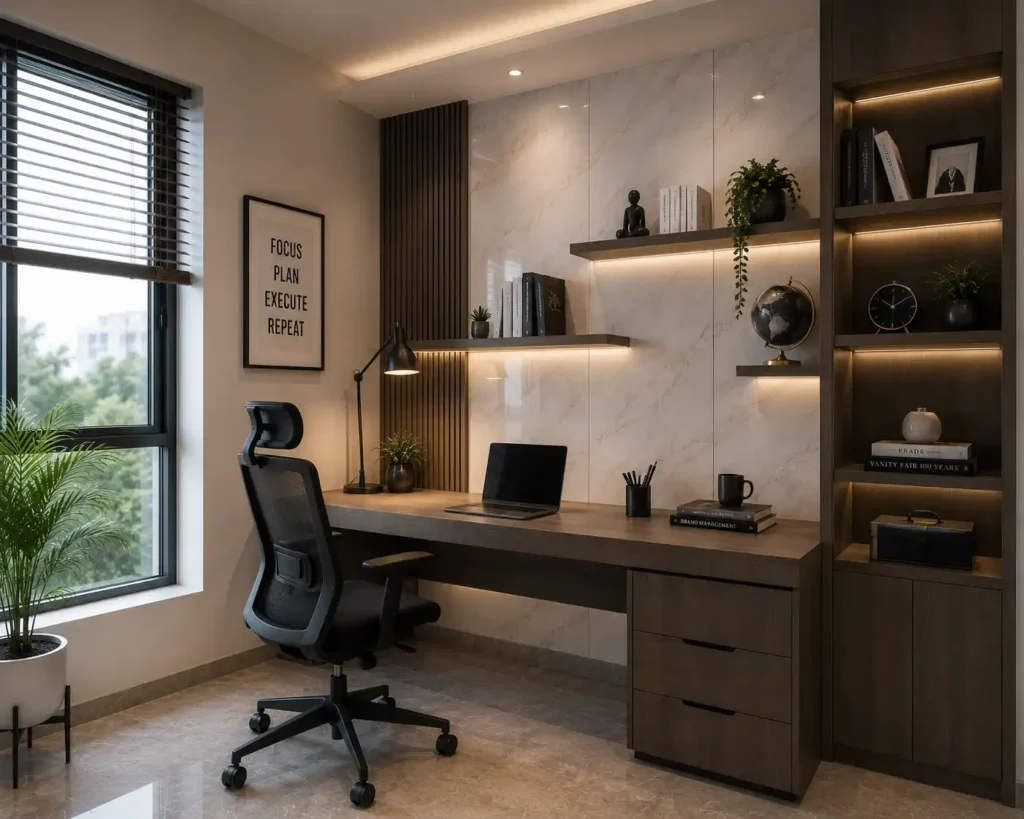
The phrase “functional premium” is specific. It is not premium-for-its-own-sake. It is premium that does work.
In a study or home office, functional premium means:
1. The surface reads as designed on camera in both daylight and evening light
2. The room feels distinct from other parts of the home, helping establish a dedicated work environment.
3. The wall remains visually comfortable across long working sessions.
4. The space communicates the user’s professional identity without overstatement
5. The investment justifies itself through daily use, not occasional showing
Functional premium is the standard the work-from-home era should be designing to. Many home offices in India still follow a guest-room or spare-bedroom design approach.
Performance Requirements for Study and Office Wall Panels
The study and office brief adds three performance requirements that the dressing room brief does not have.
Requirement 1: Camera-Friendly Surface Character
A wall behind the user on camera needs to:
1. Maintain a consistent visual appearance across different lighting conditions.
2. Avoid distracting reflections from ring lights and window light
3. Provide depth that flatters the user’s silhouette without competing with them
Some surface finishes that work in residential dressing rooms produce unwanted glare or colour shift on camera. The panel specification for office use should be evaluated under the lighting conditions in which the room will be used.
Requirement 2: Long-Session Visual Comfort
A panel the user looks at for forty hours a week needs to:
1. Avoid pattern density that becomes intrusive over long sessions
2. Hold visual interest without competing for attention
3. Support both focused work modes and decompression breaks
This is a specification consideration that most residential design briefs do not face. The user spends more concentrated time facing this wall than any other wall in the home.
Altura: When the Office Wall Should Be Quietly Architectural
Altura is the choice when the home office should read as a serious work space without making a statement that competes with the user.
Where Altura fits:
1. Founder, principal, or partner home offices where the user is the primary visual focus
2. Study rooms for senior students or researchers where focus and quiet are part of the brief
3. Consulting and advisory professional offices (lawyers, financial planners, architects) where the wall signals credibility quietly
4. Multi-purpose rooms (study by day, library by evening) where the wall needs to handle both contexts
5. Smaller home offices where a statement wall would feel claustrophobic
Altura’s surface character allows the user to lead on camera and the room to read as designed without dominating the frame. The Zoom backdrop helps create a more considered visual setting for the user.
Iconica: When the Office Wall Should Be the Frame
Iconica is the choice when the home office should make a deliberate visual statement that frames the user as the kind of person who works in this kind of room.
Where Iconica fits:
1. Creative professional home offices (design, content, advertising, architecture practice) where personal brand is part of the role
2. Founder offices for consumer-facing brands where the principal is the brand
3. Study rooms in design-led homes where the room is part of the home’s overall design voice
4. Recording or video-creation studios in residential spaces where the backdrop is a tool
5. Larger home offices with the volume to absorb a statement wall
Iconica’s surface character takes the visual lead and positions the user inside a designed frame. The room contributes to the overall impression created during meetings and video calls.
Installation Reality for Occupied Rooms
Most study and home office installations happen in active rooms. The user cannot vacate for a week. The installation profile for both Altura and Iconica suits this constraint:
1. Wall preparation (clean, level, primed) completes in two to four hours during off-hours
2. Panel installation per piece runs under two hours of active installer time
3. A full office wall (one to three panels depending on dimensions) typically completes in a single working day
4. The user can return to the space the next morning with minimal disruption
5. Adjacent walls, desk, and equipment can usually stay in place during installation
This installation profile is one of the key reasons direct-to-wall panels work for home office specifications. Alternative wall treatments may require longer installation timelines depending on the materials and site conditions involved.
Five Mistakes Architects Make on Office Wall Specification
From the home office and study specifications reviewed at the Goregaon West office:
1. Defaulting to paint in the brief. The wall behind the user is the most-seen surface in the home on camera. Paint may not address the full range of considerations outlined above.
2. Specifying the same wall as the master bedroom. The dressing room brief and the office brief differ on camera, acoustics, and long-session comfort. A panel that works in one may not be the right call in the other.
3. Choosing high gloss for a camera-facing wall. Gloss produces ring-light reflection, key-light hot spots, and window glare that distract from the user. Altura’s calmer surface handles camera lighting better; Iconica should be specified with awareness of the room’s light profile.
4. Ignoring the lighting plan. A premium wall panel under poorly planned lighting (flat overhead, no ambient wash, no task lighting balance) does not deliver the premium read. The lighting plan should be developed alongside the wall specification.
5. Underestimating the long-session fatigue factor. A bold pattern that looks great for an unboxing video produces visual fatigue across forty hours a week. The panel that the user can live with daily is the panel that earned its specification.
Each mistake is preventable at the specification stage. The work-from-home era makes the office wall a more consequential design decision than most architects are currently treating it as.
When Both Panels Work Across a Single Office Suite
In larger home office suites (founder homes, family-office spaces, multi-user studies), Altura and Iconica often pair across rooms:
1. Principal office in Altura (credibility-led, user-forward)
2. Adjacent recording or meeting space in Iconica (statement frame for varied content)
3. Library or reading zone in Altura (calm, long-session)
4. Brand or showcase wall in Iconica (statement anchor for visitor-facing moments)
The two panels working together produce a layered office environment without competing visual voices.
Final Thoughts
The home office and study wall is the most-seen surface in the working home. The work-from-home era did not change this fact; it surfaced. The specifications that treat this wall as a serious design moment produce rooms the user is glad to spend ten hours in. The specifications that default to bedroom-leftover logic produce rooms that read as such on every Zoom call.
Altura and Iconica each solve the office and study brief in a different register. The choice depends on the user’s role, the room’s lighting, and the visual hierarchy the camera should produce. When the choice is right, the home office becomes one of the rooms in the home that contributes most consistently to the user’s professional life.
Looking to create a more considered study room or home office environment?
Explore Dexarte’s Altura and Iconica wall panels and discover solutions designed to add depth, texture, and visual distinction to workspaces. Contact us now for samples, technical guidance, and project-specific recommendations.
Follow Dexarte on Instagram, Facebook, and LinkedIn for inspiration and surface innovations.